












Most content about window production lines answers one of two questions: what machines do I need, or who are the best suppliers. Neither helps you decide.
A buyer's real problem is sequence. Every choice is constrained by the one above it: pick the automation level before the takt time and you overspend; pick the machine before the layout and you install something that cannot be fed.
This guide is a decision framework, not a catalog. It walks seven steps in the order a factory should work, each ending with a concrete deliverable before you commit capital. It covers aluminum and uPVC alike and stays brand-neutral, so you can run any quote through it.

At the end you will have a weighted scorecard, a pre-signing checklist, and a list of red flags worth walking away from. For the shortest version, jump to the scorecard and the checklist.
Contents
- Step 1 — Write your production target
- Step 2 — Map the process, find the real constraint
- Step 3 — Choose your automation level honestly
- Step 4 — Vet the machine, not the brochure
- Step 5 — Design the factory around the line
- Step 6 — Build the TCO and payback model
- Step 7 — Vet the supplier like a partner
- The pre-signing checklist
- Eight red flags
- A weighted scorecard
- FAQ
Step 1 — Write your production target before you look at a machine
Every wasted equipment budget starts with a number that was never agreed. Before any supplier conversation, write a one-page production target — short enough for sales, production and finance to sign, specific enough that two suppliers would quote the same thing.
| Line | What "specific" means | Why it constrains everything else |
|---|---|---|
| Material system | Aluminum, uPVC, or both — and if both, whether they run on separate lines | Joining methods are not interchangeable. Aluminum is cut, milled and corner-crimped; uPVC is welded and corner-cleaned. |
| Product mix | The specific list: casement, sliding, louver, folding, curtain wall | Each product changes tooling, machine count and changeover time. A mix is the hardest thing to automate. |
| Output target | Units or square meters per shift and per month, at a stated shift pattern | Per-shift output sets machine count. Monthly output sets shift pattern and labor structure. |
| Order profile | Project-based, retail/standard, or mixed — with the approximate split | Project shops win on flexibility; retail shops win on cost per unit. These need opposite lines. |
| Tolerance standard | Diagonal deviation, corner gap, flatness, and the test standard you will be held to | Set the number you must hit and you can eliminate any machine that cannot prove it. |
Never let a supplier define the target for you. If the quote says "for 500 windows per month," that describes their standard configuration, not your business. Get the number in writing, tied to your product list.
The order profile is the most underestimated variable: a line built for 60 standard sliding windows per shift is a poor fit for a shop taking 20 bespoke curtain wall units a month. For context, see our aluminum window profile market report and overview of aluminium doors and windows manufacturers in China.
Deliverable: a signed one-page production target. If a step has no deliverable, it is not a step — it is a discussion.
Step 2 — Map the process and find the real constraint
Write the full process, station by station, in the order material actually moves — not the ideal order, but the order it moves today. Then measure which station consumes the most time per unit.
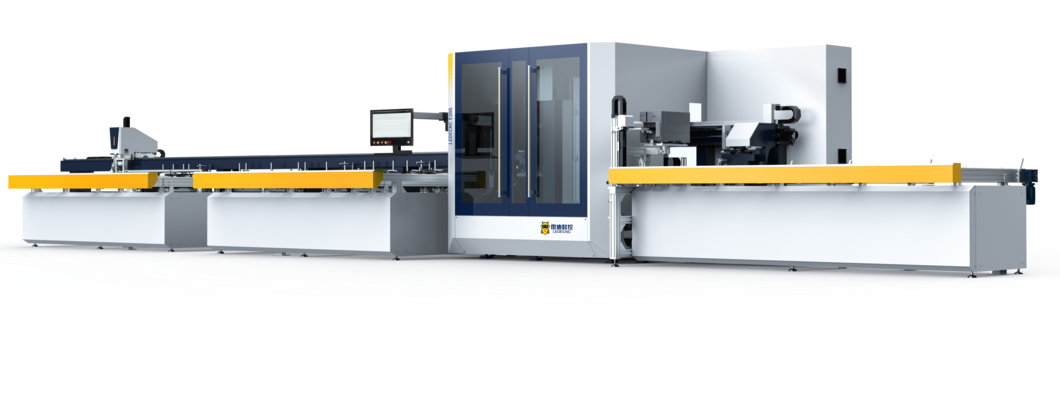
For aluminum window and door production the flow runs: feeding and cutting → end milling and drilling → surface treatment → assembly and corner connection → glazing → final inspection and packaging. LEADCNC's intelligent aluminum production line page shows the equipment for each stage; the curtain wall branch is in our guide to automated aluminum curtain wall machines and the aluminum curtain wall machine buying guide.

Then apply the only question that matters here: what is the constraint? A line is only as fast as its slowest station, so a faster saw when drilling is the constraint produces a faster saw, an unchanged output and a queue. Three questions expose it:
- Where does material wait? A queue between machines is the clearest sign of a starved line. If profiles sit waiting, the machine is the constraint — not the labor.
- How long is changeover? In a project shop, changeover often exceeds run time. The constraint is setup, not speed — this is where offline programming and stored parameters pay back fastest.
- What does rework cost? If output fails inspection and returns to a station, the constraint is upstream quality. Speeding up the failing station makes more rework, faster.
Check a fourth constraint: the order process. If engineering releases, nesting and cutting lists are still done by hand, the fastest machine will be starved by paperwork — which is why AI and automation for alloy door and window production matters, and why software returns in Step 4.
Deliverable: a process map with a cycle time per station, the constraint circled, and a note on what the constraint is not — usually the thing the vendor's demo video is best at.
Step 3 — Choose your automation level honestly
There are five levels of window production line maturity. Most factories overestimate the level they need, and a few underestimate what they already pay for.
| Level | What it looks like | What it genuinely fixes | What it does not fix |
|---|---|---|---|
| 0 — Manual workshop | Hand saws, hand drills, manual corner connection | Nothing structural; only replaces hand tools | Consistency, capacity, traceability, labor dependence |
| 1 — Single-station CNC | CNC sawing or machining replaces one manual operation | Precision on one operation; removes the worst ergonomics | Bottlenecks elsewhere; data flow; changeover time |
| 2 — Connected cells | Several CNC machines with buffer stations and shared handling | Material flow, machine utilization, some traceability | Scheduling, changeover, cross-station data integrity |
| 3 — Automated line | Robotic transfer, automatic corner connection, integrated monitoring | Throughput, labor per unit, quality variance, safety exposure | Order-level planning; mixing models on one line |
| 4 — Lights-out / dark factory | Unattended running, ERP-integrated scheduling, predictive maintenance | Everything, including planning, quality records and maintenance timing | Requires a stable, high-volume or narrow order base to pay off |
The honest decision rule: automation level follows order stability, not ambition. Level 3 suits repeatable batches. Level 4 rewards volume and a narrow, predictable mix, and punishes heavy customization — a lights-out line that needs constant re-programming is an expensive way to be inflexible.
Be equally honest the other way. If output is high and stable, staying at Level 1 is not saving money; it is a permanently higher unit cost. Our article on single machine versus full production line works through the ROI.

Deliverable: a written level decision with the order-stability reason that justifies it, plus a line count.
Step 4 — Vet the machine, not the brochure
Most buying guides describe what a machine does instead of what you must prove. A brochure is a claim; a specification with a measurement method and a tolerance is evidence. Ask for the second one, on every point.

| # | What to specify | Evidence to demand |
|---|---|---|
| 1 | Spindle count and arrangement | Layout drawing; why this count suits your product list |
| 2 | Positioning accuracy and repeatability | Numerical value and the measuring method — a cut profile test beats a brochure figure |
| 3 | Structure and rigidity | Gantry or column type; service life under your duty cycle |
| 4 | Cutting force and material capability | Maximum profile size and wall thickness in your alloy |
| 5 | Tool change time and tool capacity | Number of tools; average change time in seconds |
| 6 | Laser capability, where applicable | Whether laser replaces a station or is supplementary |
| 7 | Automatic measurement and error-proofing | Proof the machine refuses to cut out-of-tolerance stock |
| 8 | Offline programming and nesting | Software name, license model, and whether it imports your CAM |
| 9 | ERP / MES integration | Named compatible systems and a live order-import demo |
| 10 | Monitoring and traceability | What is recorded per unit, and whether QA can export it |
| 11 | Maintenance and consumables | Spindle life in hours, tooling intervals, spares list with lead times |
| 12 | Safety and compliance | Guarding, emergency stop behavior, certification for your jurisdiction |
If your line is aluminum-heavy, see our best CNC machines for aluminium, the guide to choosing a CNC machine for aluminium, and the CNC aluminum cutting machine guide. Families are under CNC machining centers and the Ultra X series processing centers.
Verify the intellectual property behind the machine
A line is a software-and-mechanical product, and both halves are worth checking. Registered software copyright and granted patents signal an engineering team doing original work — and decide whether a fix three years on is a firmware update or a workshop job.


Deliverable: a completed 12-point specification sheet, answered in writing, with the measurement method stated for every numeric claim — plus a request to watch one cut sample of your own profile machined and measured.
Step 5 — Design the factory around the line
Most line projects are designed around the machine, and the building has to bend. It is cheaper to design the factory around the line. This step produces a layout that the supplier, your installer and your architect all sign — before concrete is cut and power routed.

Five layout questions to answer with a drawing, not a conversation:
- Line length and orientation. A long line needs a long building; check it leaves room for a truck, a crane and a maintenance bay.
- Material flow direction. Profile racks in, finished units out, no crossing paths — otherwise expect handling damage and queueing.
- Storage. Profile, glass, hardware and finished goods each need allocated floor; under-allocated storage is why a commissioned line runs at half speed.
- Utility capacity. Total load for CNC, compressors, extraction and handling, with headroom — compressed air in Nm³/min and dust extraction volume checked against ceiling height.
- Maintenance, safety and expansion. Leave service envelopes, pedestrian routes and egress, plus floor loading and utility headroom for the next module.
Deliverable: a dimensioned layout drawing with flow arrows, storage allocation, utility runs and service envelopes, reviewed by the supplier in writing. If the supplier will not sign the layout, you will find the space problem after the machine is on the truck.
Step 6 — Build the TCO and payback model before the quote
Quote comparison is where buyers go wrong, because quotes compare machines while your business case must compare systems. Build the model before the quotes arrive, using your numbers from Steps 1 to 3, then fill in the supplier's numbers.
Total cost of ownership = capital equipment + installation and commissioning + factory modifications + software and licenses + training + maintenance and spares + energy + consumables (saws, tools, inserts) + labor + floor space cost − residual value.
Annual net benefit = (revenue at target output − variable cost at target output) − (revenue at current output − variable cost at current output) − the annual operating cost of the new system, including the labor it does not remove.
Payback period = capital investment ÷ annual net benefit. Use a 36-month horizon; it is usually enough to see the shape of the decision.
Three cautions change the answer:
- Labor rarely goes to zero, so do not model it that way. Model the labor that actually leaves. A line that cuts 85 people to 35 has not saved 50 in full — the 35 are still on payroll. If your case treats the headcount cut as the whole saving, you will be disappointed.
- Model changeover explicitly. A line optimized for standard sizes creates scrap when a project order arrives. Put a rework and scrap allowance into variable cost, and test at a pessimistic mix.
- Include the cost of not deciding. Lost orders, overtime, delivery delays that cost the next contract. For most growing fabricators this is the largest number in the model — and the one most often left out.
Then run the model three ways: at your target output, at 70% of target (a realistic first-year utilization), and with a 10% worse-than-expected labor outcome. A configuration that only works in the first scenario is not a safe purchase.
Deliverable: a one-page model with three scenarios, reviewed by whoever signs off on capital — before you compare a single quote, so all quotes are judged on the same basis.
Step 7 — Vet the supplier like a partner, not a vendor
A production line is a ten-year relationship. The machine is the first 90 days; the supplier is the next ten years. Evaluate them with the same rigor you applied to the machine.


Eight supplier questions that reveal most of what you need
- Who answers the phone when the line is down? Ask for a name, a direct line and a response-time commitment in the contract.
- Where are the spare parts, and how long is the lead time? For the top 20 critical parts, get a written list of stock location and lead time — a 12-week spindle lead time is an outage waiting to happen.
- Can I speak to three references running the same configuration? Ask for customers in your country, your segment, at a comparable volume.
- What is your engineering-change policy? If the design revises mid-project, who pays for the retrofit?
- What training is included, in what language, for how long? Ask for the plan, the operators covered, and whether the material is yours. Manuals are also in our user manual library.
- Do you have local service, or will you fly engineers in? Establish the cost of a visit and the expected response time.
- What is your delivery record on projects of my size? Ask for a reference project with a similar line length shipped on schedule; installation references are in our cooperation cases.
- Who owns the operating software and parameter files? Ties back to Step 4 — you want the manual, the backups and a recovery procedure at handover.
Two supporting checks. First, verify the supplier is a manufacturer, not a trader — visit if you can, and look for machines being built; the scale is on our company page. Second, cross-check the market: our 2026 top 10 window production line manufacturers compares makers from Germany, Italy, Turkey and China, and our lists of CNC machine manufacturers in China and VMC manufacturers worldwide give benchmarks.
Deliverable: a scored supplier assessment, three reference calls completed, and service and spares commitments written into the contract rather than left in a sales email.
The pre-signing checklist
Print this. Do not sign until every line is either ticked or explicitly waived in writing.
- Signed production target (Step 1)
- Process map with cycle times and constraint (Step 2)
- Written automation-level decision with line count (Step 3)
- Completed 12-point specification with measurement methods (Step 4)
- Sample cut of your own profile, measured and signed off
- Software ownership, manual and parameter backup confirmed
- ERP/MES compatibility demonstrated live
- Dimensioned factory layout signed by the supplier
- Utility loads confirmed: power, air, extraction
- TCO model with three scenarios, reviewed by the approver
- Critical spares list with stock location and lead time
- Named support contact with committed response time
- Three reference calls in your segment and region
- Training plan, language and materials confirmed
- Contract terms on service, spares, software and IP in writing
Eight red flags
Any one of these is worth a serious conversation. Several together should end the evaluation.
- Tolerance claims with no measurement method. "High precision" means nothing without the instrument, sample and conditions.
- A demo on the supplier's product, never on yours. If the machine is only shown on standard profiles, your parts are untested.
- Quoting from a standard configuration. If the quote does not reference your target line by line, they are selling their line, not yours.
- No answer on the constraint. A supplier who cannot name your bottleneck is not engineering your factory.
- Software treated as a black box. If nobody can say who owns the source or how you get a backup, treat the silence as a flag.
- Service described as "we respond fast." No named contact, no response time, no local presence. Get it in the contract.
- Price as the differentiator. A line quoted well below the others is missing something — find out what, in writing.
- No acceptance criteria. Without measurable acceptance, you cannot refuse a line that underperforms — or claim the performance you paid for.
A weighted scorecard
Run every candidate — including your current setup as a baseline — through the same weights. Weights should reflect your target, not a generic template. The structure below is a starting point for a project-based aluminum fabricator; adjust each weight to your Step 1 target.
| Criterion | Weight | Score (1–5) | Weighted | Evidence relied on |
|---|---|---|---|---|
| Machine accuracy and repeatability | 15% | Cut sample, measured | ||
| Changeover time across your product mix | 12% | Timed demonstration | ||
| Throughput against your takt time | 12% | Cycle time per station | ||
| Automation and material handling | 10% | Layout, robot coverage | ||
| Software, integration and traceability | 10% | Live ERP demonstration | ||
| Reliability, maintenance and spares | 10% | Spindle life, spares list | ||
| Total cost of ownership and payback | 12% | Your model, three scenarios | ||
| Service, training and references | 8% | Reference calls | ||
| Engineering credibility and certifications | 5% | Certs, patents, site visit | ||
| Flexibility for future product changes | 6% | Module plan, headroom | ||
| Total | 100% |
The weights reward demonstrated evidence over asserted capability, and place changeover, cost of ownership and service above brand familiarity. If you cannot point to the evidence behind a line, the scorecard has not done its job.
FAQ
How long does it take from first enquiry to a running line?
Roughly four to six months from signed order to output, with build and factory prep in parallel. Allow three months before the deposit, since most of Steps 1 to 4 happens before hardware is ordered.
Should a new factory buy a full line, or start with a single CNC?
Only if order volume is low and unpredictable. If your target is stable and repeat, a standalone machine optimizes one operation while the constraint stays elsewhere. Our comparison of single machine versus full production line sets out the crossover, and the intelligent aluminum door and window production line page shows what a configured line includes.
Can one line handle both aluminum and uPVC?
Not practically. Cutting, machining and joining differ fundamentally, and tooling, handling and software differ with them. Factories that attempt it end up with two constrained lines instead of one good one. Plan separate lines.
What does a production line actually cost?
Entirely on configuration; any number before the target is settled is fiction. The same machine can appear in a line several times the price once handling, corner connection, glazing and integration are included. Build the model in Step 6 and compare on total cost of ownership. The window making machine range and the aluminium door and window machines show how differently the same capability can be packaged.
Where to go next
The seven steps are deliberately vendor-neutral, and you should be able to run any supplier's proposal through them. When you are ready to compare real configurations against your target, LEADCNC can produce a line specification and layout proposal built around your product list, target output and building — the full range is in the product catalog, and company background, scale and certifications are on the about page.
More guides are on the LEADCNC blog and blog index, including our 2026 top 10 window production line manufacturers, the aluminum curtain wall machine buying guide and the unitized curtain wall production line reference. News is on the news page, and you can send an enquiry through our contact page.